Forex for beginners: a step-by-step start from market basics to your first trade
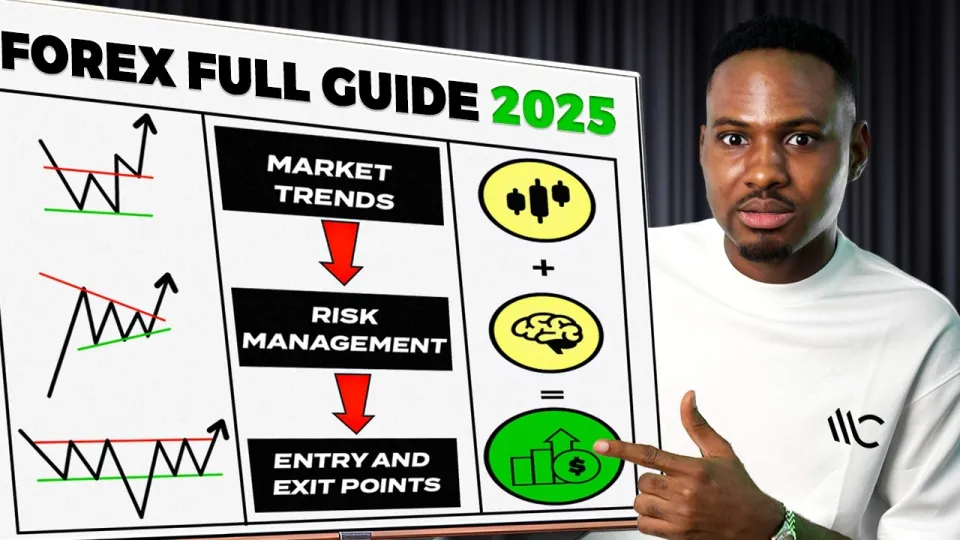
Video: How To Start Forex Trading For Beginners’ 2025 (Full Course)
You can order the same kind of articles for your own video to boost it on YouTube and Google. Just message the Telegram bot @sat_sit_bot. Articles with your video embedded are written and posted by the bot itself — on popular topical sites (no ads). Try it free: 50 articles on us.
· based on the channel Jeffrey Benson Forex
Forex for beginners is the process of learning how currency pairs are quoted and traded, opening a broker account, practising on a demo, and risking a small, fixed percentage of the account on each position. The full free course from Jeffrey Benson Forex walks through exactly that sequence, and students can follow the same curriculum through the paid plans at firepipsfx.com/plans. Nothing in it requires a large deposit; it requires a method.
What forex is and why beginners start there
Forex is the market where one currency is priced in another, so every quote is a pair: EUR/USD at 1.0850 means one euro buys 1.0850 dollars. There is no central exchange — trading happens over the counter through a network of banks, brokers and liquidity providers, which is why spreads and execution differ from broker to broker. Four instruments dominate beginner volume: EUR/USD, GBP/USD, USD/JPY and AUD/USD, because they are the most liquid and the cheapest to trade.
The profit mechanic is simple arithmetic. If you buy EUR/USD at 1.0850 and close at 1.0900, you gained 50 pips; a standard lot (100,000 units) pays about $10 per pip, a mini lot about $1, and a micro lot about $0.10. Leverage multiplies both directions of that math, which is why the same 50-pip move can be a modest gain or a wiped account depending on position size.
How the forex market works across the trading day
The market is open 24 hours a day from Sunday evening to Friday evening (UTC), moving through four sessions: Sydney, Tokyo, London and New York. Liquidity and volatility peak when London and New York overlap, roughly 13:00–16:00 UTC, and that overlap is where most beginner strategies find their cleanest setups. The Asian session is typically quieter and range-bound.
Three mechanics shape every trade you place:
- Spread — the difference between bid and ask, effectively your entry cost. It widens around news releases and at session rollover.
- Pips and lots — pip value depends on pair, lot size and account currency; calculate it before you enter, not after.
- Leverage and margin — leverage lets you control a large notional with a small deposit, but margin calls and stop-outs arrive fast when size is too big.
Economic data drives the biggest short-term moves: central-bank rate decisions, CPI, non-farm payrolls. A beginner does not need to predict them — only to know when they land and either trade around them or stay out.
The tools you actually need before the first trade
A working beginner setup is short: a regulated broker account, a trading platform, a demo account, an economic calendar and a journal. MetaTrader 5 (MT5) is the platform most courses, including this one, teach on, because it bundles charting, order types and a strategy tester in one application. The course's own route is to register with a broker, download MT5, link the account, then fund it — in that order, so the demo runs before real money does.
- Broker: check regulation and segregation of client funds first; the course recommends Assex Markets and provides a registration link.
- Platform: MT5 for charts, pending orders (limit, stop), stop-loss and take-profit attached at entry.
- Demo account: trade the exact strategy you intend to use live for at least a few weeks; the goal is a repeatable process, not a lucky streak.
- Journal: log pair, session, setup, risk, result and screenshot. Traders who write while they learn retain far more than passive viewers — a point repeated in the comments under the video.
- Economic calendar: know the red-flag releases for the week before you plan a trade.
Building a basic strategy foundation
A strategy is a fixed set of conditions for entry, exit and risk — written down, so it can be tested and repeated. The course builds one from market structure: identify the trend on a higher timeframe, mark the levels where price previously reversed, then look for a trigger on a lower timeframe. A workable beginner template looks like this:
- Pick one or two pairs and one timeframe; EUR/USD on the 1-hour chart is a common starting point.
- Mark recent swing highs and lows and the session high/low from the previous day.
- Wait for price to reach a marked level rather than chasing it mid-move.
- Enter with a stop-loss beyond the level that invalidates the idea, and a take-profit at least 1.5–2 times the risk.
- Take the trade only if the position size keeps the loss at 1% or less of the account.
Risk management is the part most beginners skip and the part that decides survival. Position size is derived from the stop distance, not the other way around: if the stop is 20 pips and you may risk $20, the correct size is one mini lot ($1 per pip). Two or three losses in a row at 1% each leaves the account down under 3%; the same streak at 10% per trade removes a quarter of it.
Placing your first trade, step by step
Placing a trade means submitting a market or pending order with a stop-loss and take-profit attached in the same ticket. In MT5: open the pair, choose New Order, set volume from your position-size calculation, enter the price (market or pending), then fill in the stop-loss and take-profit fields before pressing buy or sell. Never place the entry first and add protection afterwards — the gap between the two clicks is where beginner accounts die.
After the trade is live, the work is mostly waiting. Move to break-even only when the setup allows it, do not widen a stop-loss, and record the outcome in the journal the same day. One trade proves nothing; the first fifty do.
Common beginner mistakes and the questions they raise
Most beginner losses trace back to a handful of repeatable errors rather than bad luck. The most expensive are oversized positions, trading without a stop-loss, revenge-trading after a loss, jumping between strategies every week, and risking money that is needed for something else. A second cluster is informational: following signal channels without understanding the setup, and mistaking a demo win streak for skill.
The viewer questions under the course point to the same themes. People ask how long it takes before trading is profitable — the honest answer is months of screen time and a written record, not a fixed number of days. Others ask whether a small account can work: it can, on a micro lot, because the percentage rules do not change with account size. And a recurring doubt is whether risk management is really necessary — the traders who say they finally understood it after an hour of instruction are describing the single concept that keeps an account alive.
Useful links from the course
- Fire Pips FX plans and student access — the course author's paid mentorship tiers.
- Free daily signal channel — one free trade idea posted daily on Telegram.
- Assex Markets registration — the broker recommended in the video.
- Premium signal group access — subscription bot for the paid signal group.
Bottom line
Forex for beginners comes down to a sequence, not a secret: learn how pairs are quoted, understand sessions and costs, set up a broker account with MT5, write a simple strategy with a fixed stop-loss, and size every position so a losing streak cannot end the account. The free full course from the Jeffrey Benson Forex channel covers that arc in eight blocks, from market basics to the mistakes that empty new accounts, and is a reasonable first watch before risking any money. Treat the demo phase as the real exam, and the funded account as the graduation. If structured guidance is what is missing, the student plans at firepipsfx.com/plans are the author's own next step.
Key takeaways
- Forex is an over-the-counter market where currencies are quoted in pairs such as EUR/USD; there is no central exchange.
- Trading runs 24 hours a day, five days a week, across four sessions: Sydney, Tokyo, London and New York.
- The standard beginner toolkit is a broker account, MetaTrader 5 (MT5), a demo account and a trading journal.
- Risk per trade should be a fixed small percentage of the account, with the stop-loss placed before entry.
- Jeffrey Benson Forex structures its free course around eight blocks, from "What is forex" to "Common mistakes to avoid".
Source: How To Start Forex Trading For Beginners’ 2025 (Full Course) · Markdown version
Questions & answers
How much money do I need to start forex trading?
You can start with a small account because micro lots cost about $0.10 per pip, so a few hundred dollars is enough to trade with a 1% risk rule. What matters more than the deposit is that the money is disposable and that position size is calculated from the stop distance. Many beginners spend several weeks on a demo first.
How long does it take to become profitable in forex?
There is no fixed timeline, and anyone promising one is selling something. Realistically it takes months of consistent screen time, a written strategy and a journal of at least fifty trades before results mean anything. Progress shows up as fewer rule violations, not as a lucky winning week.
Do I need MetaTrader 5 to trade forex?
No platform is mandatory, but MT5 is the one taught in the course because it combines charting, order types, stop-loss and take-profit in one ticket, plus a strategy tester. The workflow is to register with a broker, download MT5, link the account, then practise on demo before funding.
Is risk management really more important than the strategy?
For a beginner, yes. A mediocre strategy with a 1% risk cap survives long enough to be improved, while a good strategy at 10% per trade can be erased by three normal losses. Fix the risk first, then refine entries and exits.